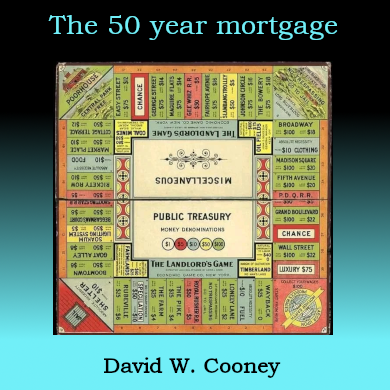
The affordability of housing is a issue that has plagued several administrations of the US government. Many solutions have been tried, and the negative impacts on the average family have generally far outweighed any benevolent intent. There are several reasons for this, but one common factor is that none of these solutions have ever attempted to address the fact that the increase in property prices has far exceeded both the average inflation rate and average wage increases. Before we look at why this aspect of the issue is never addressed, I want to look at the potential outcomes that would, in my opinion, likely be the result of implementing a 50 year mortgage.
The stated goal of implementing a 50 year mortgage is to reduce monthly mortgage payments needed to buy property. This is on the basis that the monthly payment for a loan spread out over 50 years is significantly less than the same loan spread out over just 30 years. One question that must be asked is if this loan term is specifically for lower income purchasers of a house specifically to live in, or if it will also be open to property speculators who treat property as a commodity investment. The answer to this question will have a big impact on the ability of a 50 year mortgage to enable lower income families to purchase a home. However, even if property investors, who seek to purchase properties to rent for income, or who treat property like a commodity investment, are not allowed to access this 50 year term, they will still be competitive buyers of the same properties. If they are allowed access to 50 year mortgages, then they have even more incentive to buy up property, especially to have as rentals. They can keep their rent rates the same and make a good deal more profit on a monthly basis. Investors who seek short term gains by “flipping” houses, the process of buying a house, making improvements, and then selling at a higher price, will also benefit if they can pay a less on their mortgage for the duration of the flipping process.
The fact that families looking for a long term home will still be competing with investors looking for a source of long term business income, or looking for short term gains by flipping houses, means that housing prices will likely not go down. The idea is intended to increase the total number of potential buyers by making payments more affordable to lower income families and individuals. However, simple “market dynamics” tells us that increased buy pressure (meaning that there are more people making offers to buy something) results in increased prices. So, it seems likely that, in our capitalist system, the result of implementing a 50 year mortgage will be an increase in purchase price even without considering investors. The more it increases, the more it negates the affordability based on achieving lower payments. Increased price means larger loans. If the interest rates and length of loans are equal, a higher loan amount means a higher monthly payment.
Mortgage banks will certainly love the idea of a 50 year mortgage because the total interest payments on the same purchase amount will nearly double over the extended term of the loan. In addition, the rate of principal ownership over time by the home buyer will be much lower. Since few people these days buy a home with the idea of living in it for the rest of their lives, they will find that the result of lower monthly payments means that they will owe a lot more on the loan when they are ready to sell. What is unknown is if the rate of increase of property prices will make up for that increased debt burden carried out over time. If a family finds itself in need to sell a house due to some financial difficulty, they will find that they still owe the majority of the loan, even if 15 years has passed they could be in a situation where their remaining debt is more than the crashing value of their home. Imagine how many more homes would have had to be foreclosed in 2008 if most loans at that time had 50 year terms.
This fact leads to another impact of this plan, the ability to pass on your property to your children. Of course, people who buy a home using a 50 year mortgage will be able to pass on the title of ownership to their children. However, it is far more likely that they will be unable to pass on a house that is free of debt, or even near the end of its debt. If someone purchases a home when he is 20, that home won’t be paid off until he’s 70. For most people, however, they probably won’t be able to afford buying a home until some time in their mid to late 30s. I guess they can just forget about retirement. I think it’s likely that the result will be the need to establish even more government assistance programs for the elderly for whom the carrying of a mortgage into retirement will mean they will be in worse financial circumstances than previous generations. The retirement age will likely have to be raised again, but that doesn’t mean that the elderly will be actually able to keep their jobs as they approach their golden years. Then again, maybe the idea of retirement and the Ponzi scheme we call Social Security will have been abandoned by then. (Yes, I know that Social Security is not legally a Ponzi scheme, but it is close enough to deserve the title in my opinion.)
In the end, who really benefits from a 50 year mortgage? The mortgage banks do. Property investors do. Those who advocate for large scale social welfare programs managed by the highest levels of government will also likely benefit. The people I think won’t really benefit are the low income people who actually buy a home with a 50 year loan, and those who rent their living space.
So I believe this new proposed solution to the issue of housing affordability will not fare any better than previous attempts. One thing that is never considered is a program or plan to actually reduce housing prices. There are several factors that result in the constant rise of housing prices at a rate that exceeds income and inflation: The commodification of family dwellings by people who have no ties to the local communities where these properties exist. The fact that immigration rates, both legal and illegal, exceed our dwindling birth rates so that there are more people seeking to purchase the limited number of family dwellings. Resources and labor available to build new family dwellings. All of these are basic market forces that work to constantly increase the purchase price.
However, there is no interest in bringing the purchase price of family dwellings down because our ruling economic philosophy views all property, including family dwellings, as a commodity investment. The banks, property developers, local and state governments that want to collect property tax, and those who have purchased dwellings as profitable investments will use all of their economic influence to ensure that the direction of housing prices only moves in one direction – UP.
 Practical Distributism