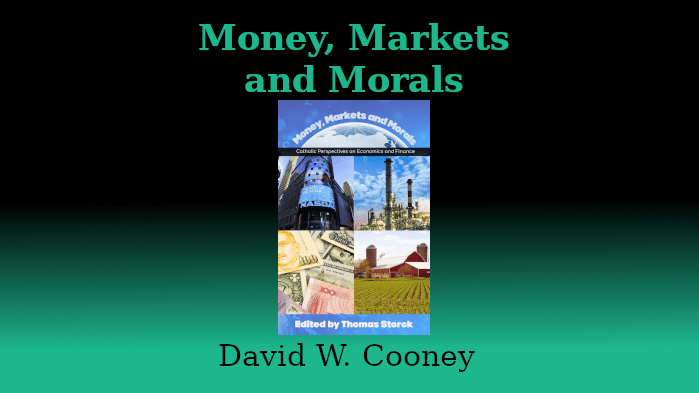
Earlier this year, a collection of essays was published to present Catholic perspectives on economics and finance; Money, Markets and Morals, edited by Thomas Storck. Through these essays, Mr. Storck presents a view that challenges conventional thoughts on how the economic life of society relates to the people in that society. While the conventional view presents economics as something that is essentially morally neutral, the authors, including myself, point out that economic activity has definite moral implications.
By considering the moral aspects of economics, the reader can see how certain practices currently accepted in capitalist societies can have negative impacts on people. Usury consolidates wealth by transferring it from the working classes to those who are already wealthy. The consolidation of wealth results in a small number of people being able to influence the policies of government to their own advantage instead of for the benefit of all. The consolidation of wealth also reduces real economic competition in the market, which results in prices that don’t match their true economic values. The modern corporation allows those who can afford to “invest” in companies to reap the rewards of profits while being protected from any liability if those profits are earned by unethical or illegal means. The types of marketing and advertising we accept and allow manipulate the public to engage in wasteful purchases that increase profits while causing harm to society. An economy that views profit as the highest good results in unscrupulous labor practices and artificially low wages.
Although these essays specifically present Catholic perspectives on these issues, I believe that even non-Catholics can appreciate many of the points which Mr. Storck has presented in this collection. These are points that can be seen and understood by anyone.
 Practical Distributism