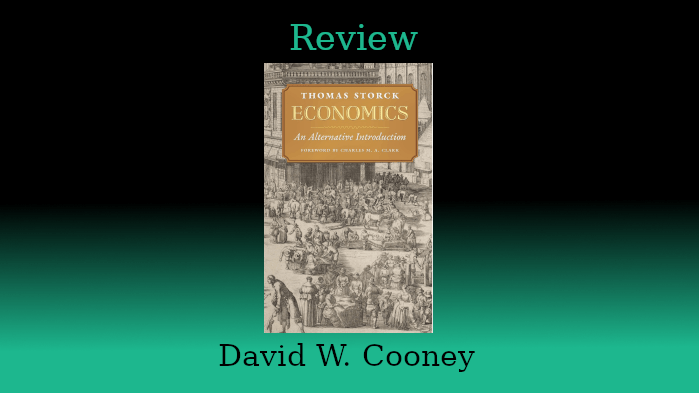
Economics is a field of study that has been researched and refined for centuries. Those seeking to learn about economics can readily find educational courses and other materials to learn all about it. You might think that, of all things, a basic introduction to the field is hardly necessary at this point. So why would Thomas Storck publish a new introduction to the topic of economics, and why is this book an alternative introduction to a field that has been so thoroughly studied? The reason is that the standard introduction to economics assumes a particular perspective as though accepting that perspective is the only reasonable way to look at economics.
The standard way of looking at economics could be summarized that you simply need understand supply versus demand and how economic efficiency fits into that equation. It is true that the standard study of economics encompasses far more that this, but this seems to be the starting point, the basis of all the more complex aspects of the field. This sterile position makes economics appear to be a morally neutral field of study as though it is nothing more than a specialized field of mathematics. It can stand on its own because, even though other aspects of society can impact its economy, economics itself is a simple and basic science like math, or even engineering.
Thomas Storck’s introduction challenges this perspective. This challenge is important for society because the perspective from which you view economic activity will impact the end goals of that activity in society. If economics is truly morally neutral, then so are economic decisions and actions. They can be justified on the basis that what is being done is not personal, it’s just business. The reality is that economics has historically been viewed as having serious moral consequences in society. Economics was once almost universally considered to be a subcategory of ethics. Storck shows how this different perspective results in very different views on wages, regulations, and many other factors of economic life as it operates within a society. I wholeheartedly recommend this book to anyone who is interested in considering different perspectives.
 Practical Distributism