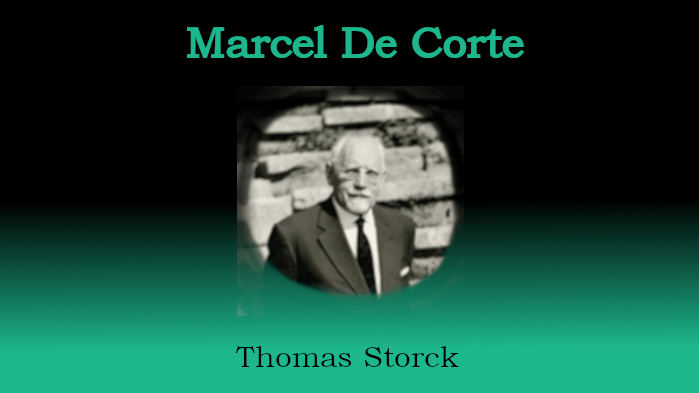
Marcel De Corte was a 20th century Belgian philosopher whose thought had considerable kinship with distributism. He championed an organic civilization rooted in the concrete and recognized the totalizing tendencies in modern systems of thought, both socialist and capitalist. Recently Arouca Press in Waterloo, Ontario has published translations of two of De Corte’s books, Intelligence in Danger of Death, translated by Brian Welter, (https://aroucapress.com/intelligence-in-danger-of-death) and On the Death of a Civilization, translated by my wife, Inez Fitzgerald Storck, (https://aroucapress.com/on-the-death-of-a-civilization) for which latter volume I wrote the introduction below.
HISTORICAL INTRODUCTION
Thomas Storck
The philosophical and social outlook of such a thinker as the Belgian philosopher and Liège professor Marcel De Corte (1905-1994) can only be understood within the context of the Church’s response to the modern world, and the subsequent Catholic intellectual revival, which in essence was a reassertion of the Church’s spiritual, intellectual and social heritage as an alternative to modernity. This revival, which began haltingly in the first half of the nineteenth century, reached its apogee in the 1930s, and petered out sometime after 1960, frames the thought of De Corte as it has of many another figure. This revival is marked chiefly by two related features. One is the recovery of the philosophical thought of Thomas Aquinas, while the second is an approach to the social order that sets it apart from the general tendencies of modern thought.
De Corte was explicit about both these points: “I have not philosophized except through my reading of Aristotle and St. Thomas Aquinas…”1 he wrote, and as to the second point, readers of the volume in hand, as well as of his other work published by Arouca Press, Intelligence in Danger of Death, will readily perceive the contours of his critique of the contemporary social order. Thus De Corte did not philosophize or speak on social questions in a vacuum. As I said, he shared a basic orientation with a host of other thinkers, including even non-Catholics who perceived both the intellectual bankruptcy of modern philosophy and the sterile socio-political debates that are endemic to our civilization, as well as our alienation from each other, from the natural world, from all that is authentic to human life. These writers created a powerful response to modern life, a response that seemed to be connatural with the Catholic mind and which for nearly a hundred years gave a distinctive tone to Catholic thought. That this response to modernity was largely abandoned in the mid-twentieth century is one of the greatest tragedies in the history of the Church.
In order to understand this twofold stance of De Corte and of the thinkers of the Catholic revival generally, it is necessary to grasp the radical and immense change which modernity introduced, and its corresponding effect upon Catholics. The Catholic Church existed at first within a Jewish milieu, different from and opposed to the paganism which reigned in the rest of the world. Although the Church, in what has been called the “first wholly fundamental turning point in the history of Christianity,” broke out of her original mode of thought and life and entered into an engagement with pagan philosophical thought, an action which made it possible for her to “set out on its missionary journey across the Mediterranean world, and across different nations, ethnic groups, cultural and social strata,”2 we are entitled to see this change as less fundamental than one might think at first. For in different ways both Hebrew and pagan thought conceived of the universe as a cosmos, an order ruled by unseen powers who controlled the destiny of individuals and nations and to whose will and purpose it was our task to conform ourselves.
The Church understood paganism, as St. Paul’s discourse in Acts 17 makes clear, for both Hebrew and Greek milieux were sacral cultures, as was obviously the new culture which the Church herself was in process of creating and which took elements from both the Jewish and gentile cultures. Thus the Church rested securely in the civilization which was coming into being, the product of her own life and activity, which reached such brilliance during the High Middle Ages. But equally obviously that civilization declined, slowly and unevenly, to be sure, but it declined and it eventually disappeared.
What came after that is modernity, an epoch whose essence so many have struggled to grasp. However we interpret it, the main point to perceive here is that modernity came into being largely as a rejection of the culture of Christendom. The Church did not create this new era and as a result Catholics struggled to understand it and to mark out its main features. It was foreign territory. For “Christians and pagans had much more in common with each other than either has with a post-Christian.”3
The triumph of the bourgeois parliamentary regime in England in 1688 and the American revolution of 1775 had little direct effect on the Catholic world. And despite the incessant activity of Enlightenment thinkers during the eighteenth century, even within historic Catholic cultures,
the broad Catholic laity, as well as most of the Catholic clergy and religious, for a long time continued to live in social enclaves relatively immune from infection by the small subculture of the liberal bourgeois intelligentsia. This was particularly so in the case of the still vast Catholic peasantry. Further, within Catholicism, even when liberal infection did threaten, ecclesial censorship and burning of printed books, backed up by repressive Catholic state power, held the Enlightenment in check for a long time.4
But then the French Revolution occurred, in the heart of Catholic Europe, an event which overturned the already decaying Catholic social order built up over more than a thousand years, and for which the demise of the thousand-year old Holy Roman Empire in 1806 may be taken as a symbolic end.
It was understandable that many Catholics, after the final defeat of Napoleon in 1815, wanted nothing more than a return to the pre-1789 social order. And at first it seemed as if something akin to that could be achieved, at least in the political arena. But while under Metternich’s sway politics may have been relatively calm until 1848, this was hardly the case in the intellectual realm, where a ferment of new and often contradictory ideas flourished. In addition to the continuing influence of the thought of the eighteenth century, other movements arose in opposition to that. The Romantic movement gave rise to diverse, even contradictory, cultural streams, and in an exaggerated rejection of the Enlightenment’s conception of reason, thinkers such as Louis Bautain or Louis Bonald abandoned natural theology as a preamble of faith, and looked instead to a primitive revelation, handed down from Adam, as the ultimate foundation for belief.
During the preceding two centuries or so, many Catholic thinkers had adopted views taken from contemporary philosophical currents, especially those of Descartes, and by early in the eighteenth century “the influence of [Descartes’] philosophy had penetrated ecclesiastical seminaries in spite of official prohibition and discouragement.”5 Indeed, Leo XIII noted that “systems of philosophy multiplied beyond measure” and that they even “caught the souls of certain Catholic philosophers, who, throwing aside the patrimony of ancient wisdom, chose rather to build up a new edifice than to strengthen and complete the old by aid of the new…” (Encyclical Aeterni Patris, (no. 24). But early in the nineteenth century, chiefly in Italy, Catholic thinkers began to turn to St. Thomas and to the task of gaining or regaining a more complete understanding of his thought and of its application to the changed world of modernity, an effort crowned by Pope Leo with his vigorous endorsement of the philosophy of St. Thomas in his Aeterni Patris of 1878.
Similarly in the social order new and previously unknown ideas were in the ascendant. Medieval Christendom had conceived of society organically, as akin to a family, with varying roles and duties assigned by nature and custom to different persons. This meant among other things that the economy was not seen as a separated sphere of social life ruled by its own inexorable laws, but as part of a larger whole which included all of human activity. Although the mercantilism of the Baroque Catholic monarchies had in many respects hollowed-out the medieval economic order, still there was a sense that the economy ought to serve the common good and that the state had a definite role in bringing this about. The craft guilds had been the lynchpin of the medieval economic order and they continued their activity even into the nineteenth century, especially in Germany, although more and more in a decayed state. The role of the guilds in resisting the advent of capitalism was described by Karl Marx himself in these words:
The rules of the guild…by limiting most strictly the number of apprentices and journeymen that a single master could employ, prevented him from becoming a capitalist. Moreover, he could not employ his journeyman in any other handicraft than the one in which he was a master. The guilds zealously repelled every encroachment by the capital of merchants, the only form of free capital with which they came in contact. A merchant could buy every kind of commodity, but labour as a commodity he could not buy…. On the whole, the labourer and his means of production remained closely united, like the snail with its shell, and thus there was wanting the principal basis of manufacture, the separation of the labourer from his means of production, and the conversion of these means into capital.6
But with the appearance of the theoreticians of the capitalist order an entirely novel approach to the social order had arisen.
[L]abour itself was coming to be regarded as a commodity exchangeable for benefit’,…. This brought labour out of the guild system of solidarity and into the system of exchnge; it replaced work or calling as a fixed status, inherited or acquired, with its own honour’, by occupational mobility and a free market in labour. It legitimized the transition from a guild-based and mercantilist economy to a free-market economy in the full sense; and it enabled the future science of political economy to disregard any rights of labour that were not justifiable in terms of exchange value.7
It was the Revolution of 1789 in France which gave this new conception of society free rein in Catholic Europe, abolishing the remnants of the medieval Catholic economic order, allowing the “enclosure of common lands for property-seeking rural entrepreneurs, banning of trade unions among the working class, and abolition of the feudal guilds and corporations of artisan monopolies.”8 As De Corte remarks in this volume, “Trades, stricken in their cohesiveness by the Chapelier Law, are swept into the orbit of an unbridled capitalist economy where the mathematical abstract law of profit above all things holds sway….” None other than Friedrich Engels described the post-1789 situation in these words:
The antagonism between rich and poor, instead of dissolving into general prosperity, had become intensified by the removal of the guild and other privileges, which had to some extent bridged it, and by the removal of the charitable institutions of the Church. The “freedom of property” from feudal fetters, now veritably accomplished, turned out to be, for the small capitalists and small proprietors, the freedom to sell their small property, crushed under the overmastering competition of the large capitalists and landlords, to these great lords, and thus, as far as the small capitalists and peasant proprietors were concerned, became “freedom from property.”9
The new economic order was animated by a very different spirit from that which had prevailed in Christendom, a spirit based in the final instance on a new concept of man himself.
Fundamentally modern political thought rests upon two related concepts, that of the natural solitary individual who enters into a social compact, and as a consequence, that of the state as the only significant human collectivity. We may take John Locke as the representative figure here, for his account of the social contract preceded Rousseau’s by half a century and had much more influence than Thomas Hobbes’ earlier and more dire version. Locke writes,
To understand political power aright, and derive it from its original, we must consider what estate all men are naturally in, and that is, a state of perfect freedom to order their actions, and dispose of the possessions and persons as they think fit, within the bounds of the law of Nature, without asking leave or depending upon the will of any other man.10
According to this account, in its original and native state human nature is autonomous, men are essentially solitary, free from obligations toward others (except those of the natural law), masters of themselves. It follows from this that any bonds between men must be freely chosen. This is to establish for the first time a contractual society, “one of the greatest upheavals in man’s view of himself and the world.”11 For previously it had been obvious to social and political thinkers that human beings, far from being by nature solitary and autonomous, were naturally parts of various social nexus. The political community or polis was the natural home of mankind, but within that community various other communities flourished in an organic whole, as part of a complex of smaller communities.
[W]ithin the city, the autonomous corporate organization of the different economic activities in the economic and social life of the community, by means of the gild system, corresponds perfectly with the doctrine of the organic differentiation and mutual interdependence of the members of the Christian society. Thus the medieval city was a community of communities in which the same principles of corporate rights and chartered liberties applied equally to the whole and to the parts. For the medieval idea of liberty, which finds it highest expression in the life of the free cities, was not the right of the individual to follow his own will, but the privilege of sharing in a highly organized form of corporate life which possessed its own constitution and rights of self-government. In many cases this constitution was hierarchical and authoritarian, but as every corporation had its own rights in the life of the city, so every individual had his place and his rights in the life of the gild.12
Since in Locke’s view human beings are essentially autonomous individuals who originally enter voluntarily into civil society and as a result establish a state, the state becomes the only significant and effective corporate body and assumes a more important role in society and its regulation than the medieval state had had. Intermediate groups are no longer natural and organic parts of a whole, but merely voluntary associations whose existence depends upon the desires or whims of their members. Thus as Pope Pius XI put it, “the highly developed social life which once flourished in a variety of prosperous and interdependent institutions, has been damaged and all but ruined, leaving virtually only individuals and the State”13
This is the background for De Corte’s insistent call for what he terms an organic society. “The distinctive characteristic of a true civilization is to bring together, organically, with unity in diversity, persons who without it would live as isolated individuals.”
The absence of these organic bonds colors all of modern life, in which “man admits he is incapable of participating in the real world and of working with others organically in a specific community.“
This lack of organic connections between human persons is based, in De Corte’s view, on a prior lack of an organic correspondence with the natural.
In the living, unified expression which is observed in authentic civilizations, different types of persons participate in it. Here again the analogies with nature are striking. The leaves of a tree are not identical; they only resemble each other. No two are identical in the manner of two geometrical shapes of the same dimensions or two manufactured objects cast in the same mold. The differences among leaves, flowers, fruit, branches, trunk, and root are still more obvious. All the parts of a tree, however, form one organic unity.
In Lockean thought the natural differences between persons become necessarily unimportant, since each of us is seen as theoretically independent and free, master of himself. The state or civil society is not something organic, that is, akin to an organism with differentiated functioning parts, but like a structure formed of interchangeable manufactured objects. This conception of society and of human life has been a disaster for mankind and is largely the immediate reason for the various dilemmas in which we now find ourselves. Is there any way out, any escape from the strictures which modernity has put upon us?
Whether or not we will actually embrace any exit strategy from modernity, the way has been pointed out to us repeatedly. Writers such as Marcel De Corte are part of a long line of Catholic thinkers who have not only diagnosed the ills of our times but prescribed the appropriate remedies. Will we take advantage of their advice? That is up to us. It is our choice.
Title image: Marcel De Corte, Vfnt, CC BY-SA 4.0, via Wikimedia Commons
Notes:
- “Autobiographie philosophique,” quoted in Miguel Ayuso, “Marcel De Corte y el Pensamiento Político Antimoderno,” Verbo, no. 327-328, 1994, p. 764. My translation from the Spanish. ↩︎
- Tomás Petrácek, Church, Society and Change (Lublin : El-Press, 2014), pp. 13-14. ↩︎
- C. S. Lewis, “De Descriptione Temporum” in Selected Literary Essays (Cambridge : Cambridge University, 1979), p. 5. ↩︎
- Joe Holland, Modern Catholic Social Teaching: The Popes Confront the Industrial Age, 1740-1958 (New York : Paulist, c. 2003), p. 35. ↩︎
- Frederick Copleston, A History of Philosophy, vol. 4 (Garden City, N.Y. : Doubleday, 1963), p. 183. ↩︎
- Capital, chap. 14. In the Encyclopaedia Britannica Great Books of the Western World edition (Chicago, 1952), this quote is on p. 175. See also p. 149 (chap. 11). ↩︎
- Antony Black, Guilds and Civil Society in European Political Thought from the Twelfth Century to the Present (Ithaca : Cornell University, 1984), pp. 154-55. ↩︎
- Joe Holland, Modern Catholic Social Teaching, p. 37. ↩︎
- “Socialism: Utopian and Scientific” in Karl Marx and Friedrich Engels, Basic Writings on Politics and Philosophy (Garden City, N.Y. : Doubleday, 1959), p. 72. ↩︎
- Concerning Civil Government, Second Essay, no. 4. ↩︎
- Antony Black, Guilds and Civil Society in European Political Thought, p. 157. ↩︎
- Christopher Dawson, Religion and the Rise of Western Culture, (New York : Sheed & Ward, 1950), p. 206. ↩︎
- Encyclical Quadragesimo Anno (1931), no. 78. ↩︎
 Practical Distributism

One thought on “Marcel De Corte”