Although there are still quite a number of people clinging to the idea that the world is afflicted by a crisis of overpopulation, those who are aware of the statistics know better. In fact, a demographic collapse seems much more likely than a crisis of too many people. Keeping in mind the well-known figure of 2.1 children per woman to keep a population at replacement levels, according to 2020 figures from the World Bank, the overall fertility rate worldwide is 2.3. Italy’s fertility rate is 1.2, Spain’s 1.2, South Korea’s 0.8, Russia’s 1.5, India’s 2.1 and China’s 1.3, the United States’ 1.6. There are a few countries comfortably above replacement rates, but even in those the rates are nearly all falling.
Given these dismal statistics, one naturally asks what are the causes. One would be naive to reject the idea that our religious and cultural outlook does not play an important role, but equally naive to ignore economic factors. According to The Economist magazine (2/18/23) “women are often not opposed to having children; they are having fewer than they say they want, mostly for economic reasons.” Lack of steady jobs, for example, seems to be one of drivers of delayed marriage and hence reduced child-bearing in a country such as Spain.
But there are other factors, as well, and one that seems to be of most importance in this country is the question of affordable housing. Long ago, in July of 1949, Pope Pius XII emphasized the importance of the housing question in a speech to the women of Italian Catholic Action:
The Catholic Church strongly supports the requirements of social justice. These requirements include provision for the people of the necessary houses, and above all for those who desire to found a family or are already doing so. Can there be conceived a social need of greater urgency? How sad it is to see young people, at the age when nature is more inclined to marriage, forced to wait years and years, merely because of the lack of a place to live….
One of the problems affecting housing in the United States, and perhaps elsewhere, is the purchase of apartment buildings and houses by investors, often large firms whose only concern is their profit and who often raise rents drastically and with no regard to their real costs of maintenance or a reasonable return on their investment. Although a distributist can certainly recognize that there is a modest place for rental property in the mix of our provisions of housing, landlords do not have the right to simply charge whatever the market will bear. Rather their rental income ought to have some relationship to costs of maintenance and a reasonable return on their investment. And the more that landlords are members of the same community as their tenants, the more likely that such relationships will remain within the bounds of justice and charity and stability. Landlords who rent out a house down the street from their own home, as a source of some extra income in retirement, are much more likely to be content with a modest investment income and to pay attention to the other factors which keep neighborhoods stable and healthy than are distant investors with no aim other than obtaining the greatest possible return on their investment.
This brings up one more point, however. A distributist economy can only with great difficulty be superimposed on a society that is possessed of a capitalist mentality. A capitalist mentality sees the economy as a field chiefly for personal enrichment, regardless of how this is attained. Empty speculation, hostile takeovers, currency manipulation – all these are seen as equal to work that serves the community by supplying necessary goods and services.
We need then to do two things at the same time. One is gradually to change the laws so that economic activity that contributes nothing to the good of society is discouraged or prohibited. But the other, equally necessary, is to change our way of thinking about the economy, so that we see it for what it is or ought to be – the means of providing for necessary and useful goods and services according to the demands of human nature. We all need certain things to survive and to live lives worthy of human beings. This is what public policy ought to be concerned with. The Church’s social doctrine provides here an indispensable guide and blueprint for accomplishing this. But sound policies must go hand in hand with a different orientation in our thinking about economics, or, to say it another way, a new way of thinking about economics must manifest itself in concrete laws and institutions which embody this thinking. There is no other way forward. Hence education in genuine economics is the necessary first step so that whenever opportunities do arise to alter our laws and institutions, we are prepared to act in accordance with a sound and true understanding of why God has given us both the need and the capacity to create and use the goods and services that a healthy economy should supply.
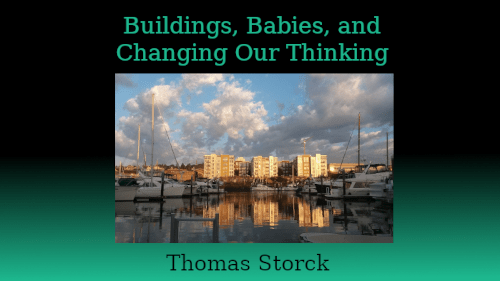
Title photo © David W. Cooney, All rights reserved.
 Practical Distributism